JN0-351 Valid Test Tutorial - JN0-351 Exam Topics Pdf
Wiki Article
BTW, DOWNLOAD part of BraindumpStudy JN0-351 dumps from Cloud Storage: https://drive.google.com/open?id=10pNyjlJLwRuWQ13qhlBnyKceJsIxtHIF
At the BraindumpStudy offer students Juniper JN0-351 practice test questions, and 24/7 support to ensure they do comprehensive preparation for the Enterprise Routing and Switching, Specialist (JNCIS-ENT) (JN0-351) exam. BraindumpStudy Enterprise Routing and Switching, Specialist (JNCIS-ENT) (JN0-351) practice test material covers all the key topics and areas of knowledge necessary to master the Juniper Certification Exam.
Juniper JN0-351 Exam Syllabus Topics:
| Topic | Details |
|---|---|
| Topic 1 |
|
| Topic 2 |
|
| Topic 3 |
|
| Topic 4 |
|
| Topic 5 |
|
| Topic 6 |
|
>> JN0-351 Valid Test Tutorial <<
100% Pass Quiz 2026 Juniper JN0-351: Enterprise Routing and Switching, Specialist (JNCIS-ENT) Marvelous Valid Test Tutorial
Our website has different kind of certification dumps for different companies; you can find a wide range of Juniper test questions and high-quality of dumps torrent. What's more, you just need to spend one or two days to practice the JN0-351 Certification Dumps if you decide to choose us as your partner. It will be very simple for you to pass the JN0-351 real exam.
Juniper Enterprise Routing and Switching, Specialist (JNCIS-ENT) Sample Questions (Q85-Q90):
NEW QUESTION # 85
You are receiving multiple BGP routes from an upstream neighbor and only want to advertise a single summarized prefix to your internal OSPF neighbors. This route should only be advertised when you are receiving these BGP routes from this neighbor.
In this scenario, which type of route should you create?
- A. aggregate route
- B. static route using the resolve feature
- C. generate route
- D. static route using qualified next hops
Answer: C
Explanation:
Both aggregate and generated routes would work, but the best choice is generated routes.
NEW QUESTION # 86
Exhibit.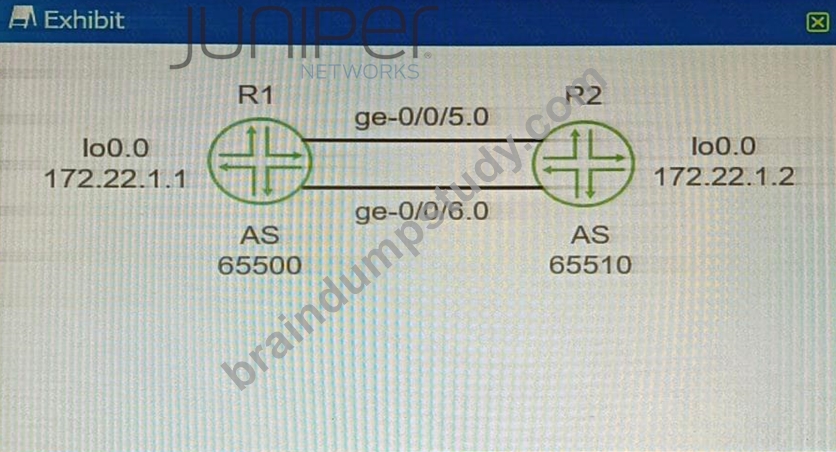
You want to enable redundancy for the EBGP peering between the two routers shown in the exhibit. Which three actions will you perform in this scenario? (Choose three.)
- A. Configure a cluster ID.
- B. Configure an MD5 peer authentication.
- C. Configure routes for the peer loopback interface IP addresses.
- D. Configure loopback interface peering.
- E. Configure BGP multihop.
Answer: C,D,E
Explanation:
A is correct because you need to configure BGP multihop to enable redundancy for the EBGP peering between the two routers. BGP multihop is a feature that allows BGP peers to establish a session over multiple hops, instead of requiring them to be directly connected1. By default, EBGP peers use a time-to-live (TTL) value of 1 for their packets, which means that they can only reach adjacent neighbors1. However, if you configure BGP multihop with a higher TTL value, you can allow EBGP peers to communicate over multiple routers in between1. This can provide redundancy in case of a link failure or a router failure between the EBGP peers.
B is correct because you need to configure loopback interface peering to enable redundancy for the EBGP peering between the two routers. Loopback interface peering is a technique that uses loopback interfaces as the source and destination addresses for BGP sessions, instead of physical interfaces2. Loopback interfaces are virtual interfaces that are always up andreachable as long as the router is operational2. By using loopback interface peering, you can avoid the dependency on a single physical interface or link for the BGP session, and use multiple paths to reach the loopback address of the peer2. This can provide redundancy and load balancing for the EBGP peering.
C is correct because you need to configure routes for the peer loopback interface IP addresses to enable redundancy for the EBGP peering between the two routers. Routes for the peer loopback interface IP addresses are necessary to ensure that the routers can reach each other's loopback addresses over multiple hops2. You can use static routes or dynamic routing protocols to advertise and learn the routes for the peer loopback interface IP addresses2. Without these routes, the routers will not be able to establish or maintain the BGP session using their loopback interfaces.
NEW QUESTION # 87
Exhibit.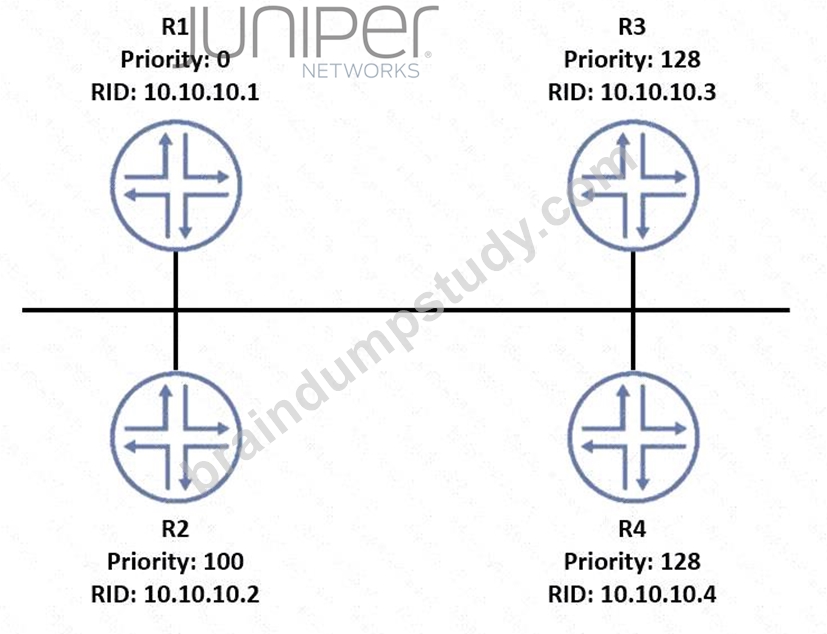
Which router will become the OSPF BDR if all routers are powered on at the same time?
- A. R4
- B. R1
- C. R2
- D. R3
Answer: A
Explanation:
OSPF DR/BDR election is a process that occurs on multi-access data links. It is intended to select two OSPF nodes: one to be acting as the Designated Router (DR), and another to be acting as the Backup Designated Router (BDR). The DR and BDR are responsible for generating network LSAs for the multi-access network and synchronizing the LSDB with other routers on the same network 1 .
The DR/BDR election is based on two criteria: the OSPF priority and the router ID. The OSPF priority is a value between 0 and 255 that can be configured on each interface participating in OSPF. The default priority is 1. A priority of 0 means that the router will not participate in the election and will never become a DR or BDR. The router with the highest priority will become the DR, and the router with the second highest priority will become the BDR. If there is a tie in priority, then the router ID is used as a tie-breaker. The router ID is a
32-bit number that uniquely identifies each router in an OSPF domain. It can be manually configured or automatically derived from the highest IP address on a loopback interface or any active interface 2 .
In this scenario, all routers have the same priority of 1, so the router ID will determine the outcome of the election. The router IDs are shown in the exhibit as RID values. The highest RID belongs to R4 (10.10.10.4), so R4 will become the DR. The second highest RID belongs to R3 (10.10.10.3), so R3 will become the BDR.
References:
1 : OSPF DR/BDR Election: Process, Configuration, and Tuning 2 : OSPF Designated Router (DR) and Backup Designated Router (BDR)
NEW QUESTION # 88
You are asked to connect an IP phone and a user computer using the same interface on an EX Series switch.
The traffic from the computer does not use a VLAN tag, whereas the traffic from the IP phone uses a VLAN tag.
Which feature enables the interface to receive both types of traffic?
- A. native VLAN
- B. MAC limiting
- C. voice VLAN
- D. DHCP snooping
Answer: C
Explanation:
Explanation
The feature that enables an interface on an EX Series switch to receive both untagged traffic (from the computer) and tagged traffic (from the IP phone) is the voice VLAN12.
The voice VLAN feature in EX-series switches enables access ports to accept both data (untagged) and voice (tagged) traffic and separate that traffic into different VLANs12. This allows the switch to differentiate between voice and data traffic, ensuring that voice traffic can be treated with a higher priority12. Therefore, option D is correct.
NEW QUESTION # 89
You are asked to create a new firewall filter to evaluate Layer 3 traffic that is being sent between VLANs. In this scenario, which two statements are correct? (Choose two.)
- A. You should apply the firewall filter to the appropriate IRB interface.
- B. You should create a family Ethernet-switching firewall filter with the appropriate match criteria and actions.
- C. You should apply the firewall filter to the appropriate VLAN.
- D. You should create a family inet firewall filter with the appropriate match criteria and actions.
Answer: A,D
Explanation:
A firewall filter is a configuration that defines the rules that determine whether to forward or discard packets at specific processing points in the packet flow. A firewall filter can also modify the attributes of the packets, such as priority, marking, or logging. A firewall filter can be applied to various interfaces, protocols, or routing instances on a Juniper device. A firewall filter has a family attribute, which specifies the type of traffic that the filter can evaluate. The family attribute can be one of the following: inet, inet6, mpls, vpls, iso, or ethernet- switching. The family inet firewall filter is used to evaluate IPv4 traffic, which is the most common type of Layer 3 traffic on a network.
To create a family inet firewall filter, you need to specify the appropriate match criteria and actions for each term in the filter. The match criteria can include various fields in the IPv4 header, such as source address, destination address, protocol, port number, or DSCP value. The actions can include accept, discard, reject, count, log, policer, or next term. To apply a firewall filter to Layer 3 traffic that is being sent between VLANs, you need to apply the filter to the appropriate IRB interface. An IRB interface is an integrated routing and bridging interface that provides Layer
3 functionality for a VLAN on a Juniper device. An IRB interface has an IP address that acts as the default gateway for the hosts in the VLAN. An IRB interface can also participate in routing protocols and forward packets to other VLANs or networks.
Therefore, option C is correct, because you should create a family inet firewall filter with the appropriate match criteria and actions. Option D is correct, because you should apply the firewall filter to the appropriate IRB interface
NEW QUESTION # 90
......
For candidates who want to evaluate and enhance their Juniper JN0-351 Test Preparation online, the web-based practice test is a perfect choice. You can attempt our 60 Juniper web-based practice exam whenever it suits you because it is accessible from any location with an internet connection. This Enterprise Routing and Switching, Specialist (JNCIS-ENT) browser-based practice exam helps you overcome exam fear as it simulates the environment of the real test.
JN0-351 Exam Topics Pdf: https://www.braindumpstudy.com/JN0-351_braindumps.html
- Latest Released Juniper JN0-351 Valid Test Tutorial: Enterprise Routing and Switching, Specialist (JNCIS-ENT) ???? The page for free download of ( JN0-351 ) on ⮆ www.examcollectionpass.com ⮄ will open immediately ????JN0-351 Reliable Dumps Questions
- Valid JN0-351 Exam Vce ⏺ Valid Dumps JN0-351 Files ???? Authorized JN0-351 Certification ???? Copy URL ▷ www.pdfvce.com ◁ open and search for 【 JN0-351 】 to download for free ????JN0-351 Pass4sure Study Materials
- Practical JN0-351 Valid Test Tutorial - Perfect JN0-351 Exam Topics Pdf - High-quality Juniper Enterprise Routing and Switching, Specialist (JNCIS-ENT) ???? Search for ☀ JN0-351 ️☀️ and download it for free on ➠ www.pdfdumps.com ???? website ????JN0-351 New Dumps
- Authentic Best resources for JN0-351 Online Practice Exam ???? Search for ▛ JN0-351 ▟ on [ www.pdfvce.com ] immediately to obtain a free download ????Latest JN0-351 Test Pass4sure
- Juniper JN0-351 Exam | JN0-351 Valid Test Tutorial - One Year Free Updates of JN0-351 Exam Topics Pdf ???? Simply search for ☀ JN0-351 ️☀️ for free download on ➽ www.vce4dumps.com ???? ????Latest JN0-351 Test Guide
- Pass Guaranteed Quiz Juniper - JN0-351 Newest Valid Test Tutorial ???? Easily obtain ☀ JN0-351 ️☀️ for free download through 【 www.pdfvce.com 】 ????JN0-351 Reliable Dumps Questions
- Latest JN0-351 Test Guide ???? Valid Dumps JN0-351 Files ???? JN0-351 New Dumps ???? Search on ( www.prepawayete.com ) for [ JN0-351 ] to obtain exam materials for free download ????JN0-351 Dumps Questions
- First-grade JN0-351 Valid Test Tutorial Covers the Entire Syllabus of JN0-351 ???? Simply search for ▶ JN0-351 ◀ for free download on ➽ www.pdfvce.com ???? ????JN0-351 Test Guide Online
- Efficient JN0-351 Valid Test Tutorial Spend Your Little Time and Energy to Pass JN0-351 exam once ???? Enter ▶ www.testkingpass.com ◀ and search for “ JN0-351 ” to download for free ????JN0-351 New Dumps
- Fantastic JN0-351 Exam Guide: Enterprise Routing and Switching, Specialist (JNCIS-ENT) grants you high-efficient Training Dumps - Pdfvce ???? Search for ⮆ JN0-351 ⮄ on ☀ www.pdfvce.com ️☀️ immediately to obtain a free download ????Valid JN0-351 Exam Testking
- Pass Guaranteed Quiz Juniper - JN0-351 Newest Valid Test Tutorial ???? Enter ➽ www.dumpsquestion.com ???? and search for ⇛ JN0-351 ⇚ to download for free ❎JN0-351 Exam Training
- learn.csisafety.com.au, safahnqc277246.webbuzzfeed.com, triplexdirectory.com, www.stes.tyc.edu.tw, directoryquick.com, e-directory2u.com, haarisionu528994.aboutyoublog.com, bookmarkingquest.com, luluwnsn524264.blogdosaga.com, your-directory.com, Disposable vapes
BONUS!!! Download part of BraindumpStudy JN0-351 dumps for free: https://drive.google.com/open?id=10pNyjlJLwRuWQ13qhlBnyKceJsIxtHIF
Report this wiki page